
Shelby Oaks marks producer Chris Stuckmann’s filmmaking debut with an eerie journey of sisterhood and the lengths one would go for family.
This is a bizarre review to put together for Shelby Oaks as somebody who grew up on Chris Stuckmann’s videos. I won’t be the first nor the last person to mention looking up to the guy. Not for the Internet fame or money, but because his passion for the arts is genuine. As cyberspace evolved to the giant mess it is today, and YouTubers became grifters—spreading nonsensical hate campaigns against filmmakers and movies—Stuckmann stayed true to his mission of talking about his appreciation for the art form.
So, seeing somebody with his values finally get his shot to prove himself as a storyteller—with the help of Kickstarter backers, a distributor like Neon, and talent such as executive producer Mike Flanagan (Absentia, The Life of Chuck)—is nothing short of inspiring. The wait is finally over. Shelby Oaks is here. Will it Stuckmannize audiences?
Synopsis
It’s been over a decade since Riley (Sarah Durn, Carry-On) and her group of paranormal investigator friends, known as the Paranormal Paranoids, disappeared. Mia (Camille Sullivan, Supergirl), Riley’s older sister, in her desperate search for her long-lost sister, becomes obsessed with the case once again after discovering a tape that might prove the imaginary demon from their childhood may have been real.
The Horrors of Reconnecting with Family
In a post Q&A with Stuckmann at a Beyond Fest screening, the first-time filmmaker mentioned how Shelby Oaks turned out to be much personal than he anticipated. Raised in a Jehovah’s Witnesses household, at some point in his life, he was forced to cut all contact with his sister after she was shunned from the church. She was deemed “spiritually dead,” and they did not reconnect almost two decades later. With that in mind, it comes as no surprise that his movie’s strongest asset is the family drama centered around sisterhood.
Both Sarah Durn and Camille Sullivan have difficult tasks for two very different reasons. On the one hand, Durn must be instantly likable yet mysterious for the audience to care about Riley’s disappearance. She does this with very little screentime, conveying fear and charm rather effortlessly. Without her aid in setting up this detective-esque story, the film wouldn’t have the gut-punch feeling it builds towards in its climax, and Sullivan wouldn’t have an emotional anchor.
Once Riley vanishes, it is up to Sullivan to carry most of Shelby Oaks on her shoulders. If Durn must leave an emotional impact with not much to do, then Sullivan needs to sustain that momentum until the movie’s final scene. What sells the latter actor’s performance is the calmness she brings to Mia at the start of the film. During a set of interviews about Riley’s disappearance, Mia is assertive and careful with her words. That easiness is shattered in the final moments of the first act as she experiences a horrible tragedy that leads her to the tape that might reveal what happened to Riley. From here, Sullivan displays paranoia in a similar vein you expect from this type of story. Yet, for what’s worth, she does it rather well.
Mia’s Unearned Arc
As good as Sullivan is in the film, Mia’s characterization, as Shelby Oaks gets closer to solving the mystery, is where my problems with the movie arise. While the world around the sisters is being built and explored in the film’s first act, an interest of Mia is established with a throwaway line. It is done with such mundanity that you almost completely forget its existence. That is, until the climax, where suddenly that throwaway line becomes a huge motivation for Mia, leading her to put her loved ones in danger in favor of this longing of hers. This ends up giving Shelby Oaks a feeling of wanting to pull a rug under the audience’s feet, and not in the best way imaginable.
Without diving into specifics, it also doesn’t help that Shelby Oaks’s big climactic sequence relies on a pair of antagonists whom we have no connection to. We’re expected to be shocked or creeped out by their actions. In reality, their motives are paper-thin, and the way in which their plans are executed has been played out tirelessly within the genre. Sullivan does her best to sell the thrills, though there is only so much she can do. By the time the credits hit, I was left confused by Mia’s arc. Shelby Oaks either needed to be longer or cut certain set pieces to dedicate more time to her psyche in relation to the decision she makes in the end.
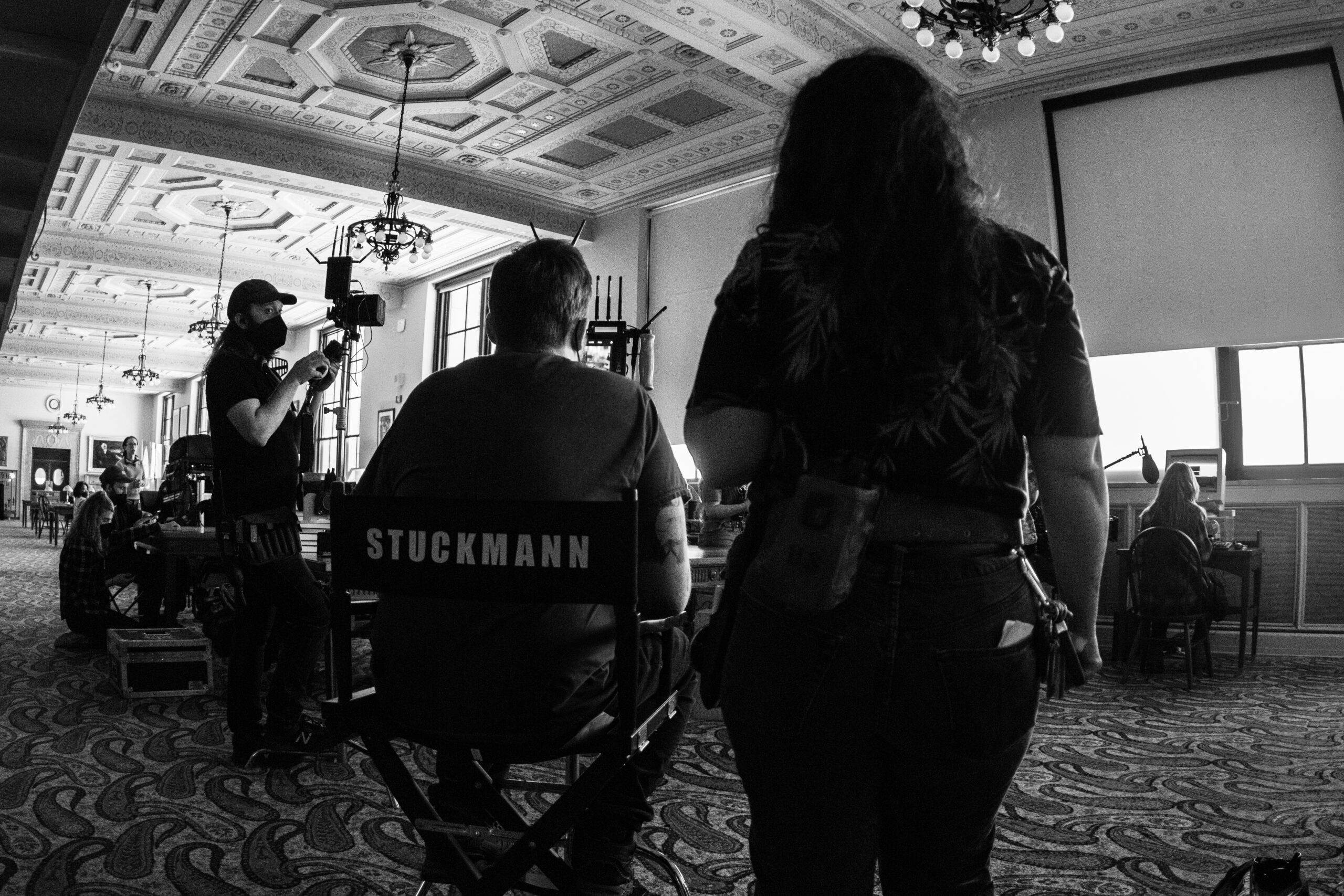
Shaping Nightmares
Within the first ten to twenty minutes, Shelby Oaks establishes a unique visual style for itself. Stuckmann’s cinematographer, Andrew Scott Baird, adds a sense of scale, history, and urgency to this relatively small narrative by switching between found footage and documentary setups to more traditional filmmaking techniques. What this accomplishes is injecting the audience with the same obsession that Mia carries. You want to learn Riley’s whereabouts, the mystery around her crew’s unfortunate end, and whether or not the supernatural entities that the Paranormal Paronoids used to investigate were real or not. A lot of it is done through dialogue, but what sells it is its visual presentation.
A sequence wherein Mia is glued to a TV screen, rewinding the footage to ensure her eyes aren’t playing tricks on what she had seen, is a particular standout in Stuckmann’s approach to horror. It is one of many scenes where you can feel Stuckmann’s love for the medium and the artists that inspired him—M. Night Shyamalan and his work in Signs are an example of one of them. The creature designs in the movie are relatively simple, yet effective. Stuckmann has a lot of fun playing with perspectives, forcing moviegoers to be alert to any sudden manifestations.
It helps that Shelby Oaks feels as tactile as it does, thanks to its locations and sets, adding a sense of texture to the environments in which our characters live. The sequence filmed at the Ohio State Reformatory in Mansfield is yet another great source for horror. Mia is swallowed by shadows, prison cells towering over her, and utter silence creating a sense of dread. The way sound is used throughout the film is powerful, especially during a moment early on involving a gun.
Final Thoughts on Shelby Oaks
As a debut, Shelby Oaks is rock solid. It won’t be a game-changer in the genre, though I suspect that is not the goal Chris Stuckmann aimed for with his first feature. The film feels like a loud declaration, a plea, if you may, to change how movies are made. Countless voices waiting for an opportunity to share their stories are out there. We are repeatedly told, either by industry professionals or your average Joe, that we should not make up excuses for ourselves when we all have a camera in our pockets. While that sentiment might come from a good place, in practice, that is precisely why it’s hard to stand out as a storyteller when the Internet is oversaturated with millions wanting to do the same. That is not to mention the lack of money to support one’s vision.
Years from now, I think we’re going to look back at Shelby Oaks’s legacy not just as Chris Stuckmann’s success story, but the success story of a loving community as well. With the support of fans and years of commitment to uplift other filmmakers, a movie like this got made because thousands of people agreed that somebody’s time to shine was here. If a studio wasn’t going to give them their shot, then we would. In these unprecedented times amidst artificial intelligence and the campaign to push artists from the arts, I truly hope more stories such as Shelby Oaks are realized and continue to inspire and terrify us.
Chris Stuckmann and Samantha Elizabeth’s Shelby Oaks comes to theaters this Friday, October 24th!
For more horror, mystery, and thriller-related news and reviews, follow The Cinema Spot on Facebook, Twitter, and Instagram! Also, follow us on Letterboxd for further feature film, short film, and limited series reviews!


