
What is the price we pay for our sins? Are we truly willing to pay that price? How far would we go for those we love? Graham Wagner and Geneva Robertson-Dworet’s Fallout Season Two continues to answer and ask these questions and more. While slightly underwhelming in parts, overall this season of the show continues to build on the existing lore towards what’s to come.
Picking up almost immediately after the first season finale, Season Two finds our three protagonists working towards a somewhat common goal. In that, each wants better for themselves, or particularly in Cooper Howard/The Ghoul’s (Walton Goggins) place, to find their own family.
Plot Summary
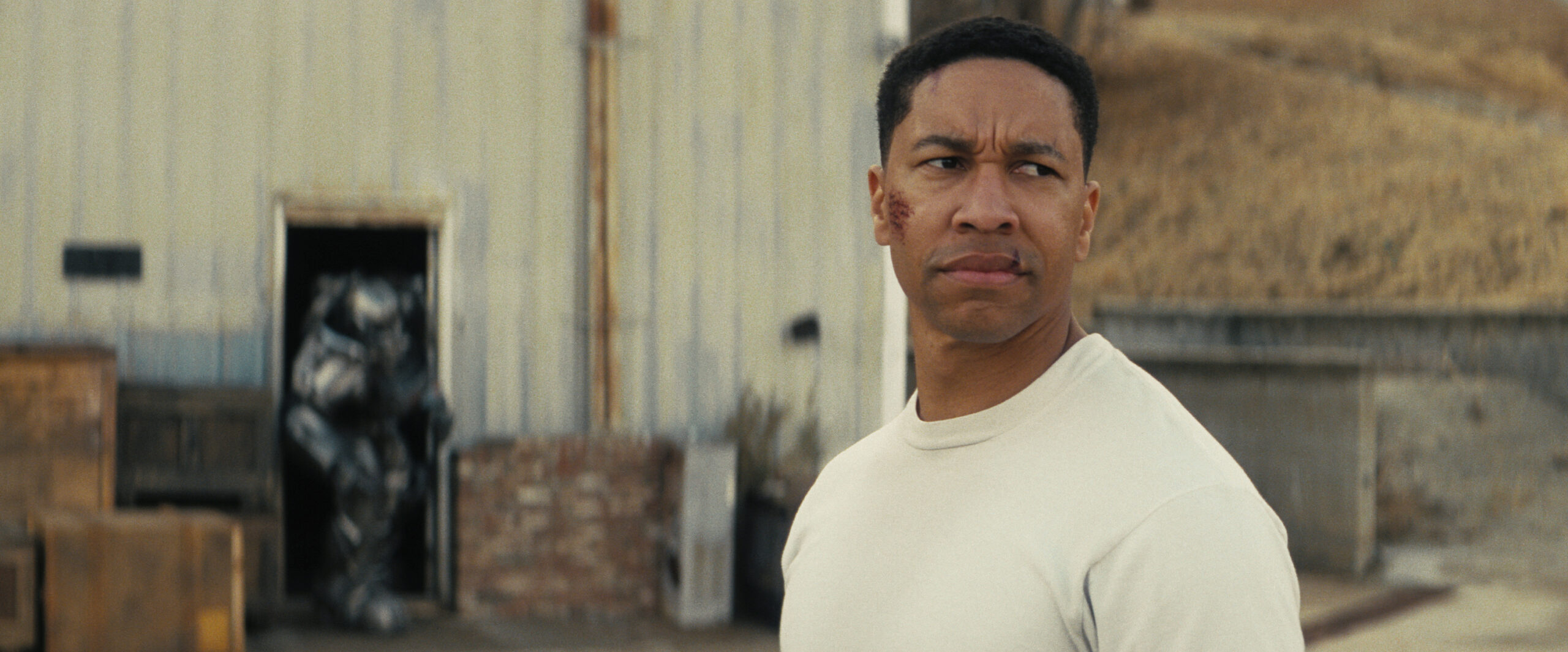
Lucy MacLean (Ella Purnell) has continued traveling with The Ghoul to New Vegas, in search of her father Hank (Kyle MacLachlan) and The Ghoul’s family. Meanwhile, Maximus (Aaron Moten) has re-grouped with his Brotherhood of Steel compatriots and essentially become numb to the horrors of the Wasteland. Maximus has become a Knight, fit with his own kit of Power Armor. One of this season’s biggest highlights is the forefront use of Power Armor. Witnessing Maximus’s use of a couple of different sets is extremely fun. Furthermore, the show’s continuous lore-building to add to the existing canon of the entire series remains a highlight of Fallout. Similar to the first, this season doesn’t bully any existing lore, and makes the show that much more whole as a concept.
The Sins of the Father
We are all defined by our parents’ sins, for better or worse. One of the show’s biggest themes is how the characters can take those sins and do better or worse for themselves. For slight context, the Fallout video game was created by Tim Cain and Leonard Boyarsky circa 1996 at Interplay Entertainment, with developer Black Isle Studios handling the development of the first game in 1997. After a few more releases, the series almost never continued after 2004 when Black Isle was closed by Interplay.
However, Bethesda Softworks, now Bethesda Game Studios, would go on to buy the rights to the Fallout series, releasing Fallout 3 in 2008, to critical acclaim. In each of the Bethesda games, except the recent Fallout 76, each player character is defined by this innate need for family, and tracing the sins of a family member in the Wasteland.

Lucy, Maximus, and The Ghoul are inherently connected through these same sins. Lucy is searching for her father. Maximus searches for his own family after surviving the bombing of Shady Sands, of which Hank is directly responsible. While The Ghoul searches for his wife and daughter, the former is also somewhat responsible for the Great War. Season Two reveals that while Cooper Howard isn’t directly responsible himself, he served as an unwitting pawn for The Enclave’s part in the Great War. More on The Enclave later.
Control
This relates to another theme of the show and series as a whole. Each player character, as well as our three show protagonists, serves as a pawn in the larger game at play for control of each area of the Wasteland. In Fallout 3, the game ends with the player character deciding how control of the purified water should be decided. In Fallout 4, the player character decides how to deal with a faction that’s been playing with the area’s outcomes, and whether to side with his own son or another faction entirely. Then, in Fallout: New Vegas, the player character decides who will control the Hoover Dam, and thus New Vegas.
Now, to digress, the main ideal here is that each is a pawn in the larger game at hand: control. Lucy, Maximus, and The Ghoul have all served as pawns in someone’s larger game before they were even aware of the game. The Ghoul has a wonderful line in the penultimate episode, “He rigged the game.” It’s another line of his that perfectly encapsulates the series as a whole. To succeed entirely, and with the most winnings, you gotta play each card on the table, and decide which card yields the highest and best result for you and you alone.
The Wasteland is Completely Unforgiving
There are parts of this show, and life in general, that are unforgiving. That’s just how life works sometimes. We gotta do the best with what we have. This is a fact that Lucy has finally realized by the final moments of Season Two. On the other hand, Maximus seems to have grasped this concept by the beginning of Season Two. The Ghoul was always aware of this. Life can throw so many bricks at you, often when you least expect it. Personally, life for this critic looked very different six months ago, but that’s neither here nor there. You do what you must; usually, we have no choice. Again, you do the best with what you have. Sometimes, the change can look better on the other side anyway. Simply, we must keep moving forward.

More than anyone, Lucy has seemed to finally grasp this and accepted that her father, while doing what he’s doing for the best of his family, is ultimately on the worst side of history. He’s sort of a bad dude, one of those “for the greater good no matter what” types. Now, this isn’t to say that Hank isn’t a compelling character all his own. Kyle MacLachlan is a cool guy in real life. Yet, he plays this role so well, and while slightly relatable, the audience can see right through his bravado. After all, he was going to mind-control his own daughter to meet his end goal so she doesn’t interfere with his strange plans. However, through her adventure with The Ghoul, she finally realizes the Golden Rule need not apply to every single person one interacts with in this bonkers wasteland.
The Enclave
The Enclave seems to be the true big bad of the Fallout show. After all, they’re usually the bad guys of the games they’re featured in. The Enclave is essentially a group of pre-war American government members, the President included. It’s always been speculated that they had something to do with the Great War. Then again, as is the mystery of the series, there has never been any complete confirmation for or against that theory. Now, it seems that audiences are getting closer to an answer than ever before, and Cooper Howard served as an indirect part of their plans. The Enclave is a pretty gnarly group. Particularly, during Fallout 3’s events, the player character is almost entirely barred from siding with them. Overall, the group’s inclusion in Season Three should be worthwhile.
Quick Highlights
Season Two provides more context for some unanswered questions from Season One. Stephanie Harper (Annabel O’Hagan) is seemingly actually Hank’s wife and more than likely Lucy and Norm’s (Moisés Arias) mother. Stephanie is also from Canada, which is a wild confirmation. If memory serves, much of what Canada is involved in is revealed in the Fallout 3 downloadable content (DLC), Operation Anchorage. However, like Hank, she’s present during the pre-war events of the series. The revelations of her part within the Vaults in the show are another great piece of storytelling. Hank and Stephanie being part of The Enclave is no surprise at all, either.
Robert Edwin House (Justin Threoux) had a body double during the pre-war American times. This is one of the series’ greatest revelations and continues to prove how much of a planner House really was. The dynamic between House and The Ghoul is one of the season’s best elements of this season. Every game has several endings, none of which are officially confirmed as canon. However, Season Two hints at either The House Always Wins or the Yes Man endings as canon for the series entirely. Although it never gives direct confirmation, the hints are good enough. They continue playing into the series’ mystery as a whole through ambiguity.
Non-Playable Characters (NPCs) from the Fallout Games
The show’s practical elements remain a constant highlight. In order for a show like Fallout to succeed, practicality seems key. There is so much to take in with each moment of the show. Every episode introduces more, whether that’s a show creation or a toss-in for loyalists of the games. The finale’s introduction of “bloatflies”, essentially just huge mutated flies, is awesome to witness. To see Norm finally get out of his predicament with the Vault-Tec employees that he unfroze from cryosleep was worth the wait with this result. Overall, Wagner and Robertson-Dworet’s continuous building on the series’ lore is more than respectable.
To continue highlighting practicality, the inclusion of the Deathclaws, effectively a mutated giant lizard with claws and horns, as mostly puppeteering, is pure chaos in the best way. In the games, they’re fairly frightening creatures. Ironically enough, that’s carried over into the show. Deathclaws were created prior to the Great War, in an effort to help with the Resource Wars.
Finally, viewers are given just a small taste of the Super Mutants. Super Mutants are the result of an experimental virus called the Forced Evolutionary Virus, more commonly called the F.E.V. throughout the games. They’re hulking, green giant, former people that were exposed to this virus in the hope of creating genetically superior human beings, either before or after the Great War. It worked, kind of. However, due to being just another cause of war, they’re highly discriminated against. At least in the games, they run in packs and attack on sight. Viewers are only shown one Super Mutant, subtly played by Ron Perlman in amazing practical makeup. Regardless, it was a great bit part and is yet another element to look forward to in Season Three.
Final Thoughts on Fallout Season 2
Fallout Season Two continues the lore-building that the series as a whole is known for. Each game has subtle references to other games or recurring characters. The showrunners continue to honor the series lore and do their absolute best to expand. As is said time and again, the decision to make a live-action video game adaptation a film versus a television show is perhaps the most important decision in the creative process. If Fallout proves anything, then it’s that making the adaptation a show was the best starting point the developers could have had to begin with.
Fallout Season Two is now streaming on Prime Video!
For more action, adaptation, drama, and science-fiction-related news and reviews, follow The Cinema Spot on Facebook, Twitter, and Instagram! Also, follow us on Letterboxd for further feature film, short film, and limited series reviews!


17 Comments on “‘Fallout’ Season Two (Prime Video) Spoiler Review – A Worthy Sophomore Outing”