
I may have been one of the few who were genuinely excited to see executive producer Kogonada take a crack at big-budget fare when he was announced as one of the directors of the now-cancelled Disney+ series, The Acolyte. Steeped in love for martial arts cinema within the Star Wars universe sounded very much like my jam, until I got around the third episode directed by the After Yang filmmaker. I was so befuddled to see that none of his imprint was felt in this nearly unwatchable, unintentionally hilarious slog. That’s not saying the show doesn’t have its merits—the fight scenes were all wonderfully realized—, but Kogonada’s episodes stand out as the most bafflingly terrible segments of an otherwise middling series.
Kogonada’s Filmmaking Style
In a way, A Big Bold Beautiful Journey, his latest filmmaking effort (a strong, necessary emphasis on the word “film”), seems like the perfect vehicle for Kogonada to bounce back from the stench of the Disney machine. This is especially true with such an incredible pairing of two of the best actors working today inside a fantastical adventure through time. In isolation, it looked like a commercially-friendly, albeit deeply personal movie, whose sensibilities—which Kogonada introduced in Columbus and further developed in the masterpiece After Yang—are apparent from beginning to end. And while A Big Bold Beautiful can definitely be considered the cheesiest thing he has directed, it is also decidedly his.
Kogonada’s sensibilities are all over this latest directorial effort, even if he did not write the screenplay. This time around, it’s producer Seth Reiss’s (The Onion, The Menu, The Regime) words that give the filmmaker an opportunity to visualize the journey on which the protagonists, David (Colin Farrell) and Sarah (Margot Robbie), will embark. The two meet-cute during a wedding and—at the suggestion of their GPS system of now-defunct Saturn cars, which they both rented at the same “Car Rental Company”—decide to go on the titular “Big Bold Beautiful Journey”. Here, they will revisit their past and hopefully extract some meaning to propel them into the future.
The Troubles Between David and Sarah
At the beginning of the movie, David and Sarah are lonely—and single—people, and are purposefully so. All will be revealed as they learn about themselves from their past, which is, like any good “time travel” movie, a combination of their most joyful and loving moments from their lives, with their most tragic and regretful. How they will open up to each other may result in a burgeoning romance, but that’s not the heart of the picture. That may be why the romance itself, no matter how great the sense of alchemy between Farrell and Robbie is, doesn’t really work and feels incredibly chintzy. It may also be why some of the dialogues, particularly in the “love story” section of the film, feel completely alien from the English language and don’t read as if we’re listening to two humans, with a strong emotional baggage, talking to each other.
Awkward Visual Language
More egregiously so, Kogonada’s second foray into commercial fare contains a significant amount of product placement, removing some of the actively textured character development in its opening section. Where the “Big Bold Beautiful Journey” starts is not within the protagonists’ minds, or in the cross-country trip they take to find doorways to their past, but inside the walls of a Burger King. Yes, David and Sarah have their first meaningful conversation not at the former’s high school, or at the latter’s favorite location—i.e., the art museum—but as they share Whoppers and milkshakes. Didn’t want Burger King? You’re going to crave one as soon as the journey opens—and ends—in the same location. Yikes.
This entire section, alongside egregious clichés in its back half that turn some of its most potent emotional scenes into mawkish button-pushing, reduces the quality of Kogonada’s visual language, but not enough to outright dismiss it. Plus, legendary Japanese composer Joe Hisaishi lends his hand to the film’s score, creating a palette so enveloping that it’s hard to genuinely feel cynical about a movie whose passion for life can be felt in each of the frames Kogonada crafts with his close collaborator, cinematographer Benjamin Loeb.
The Journey
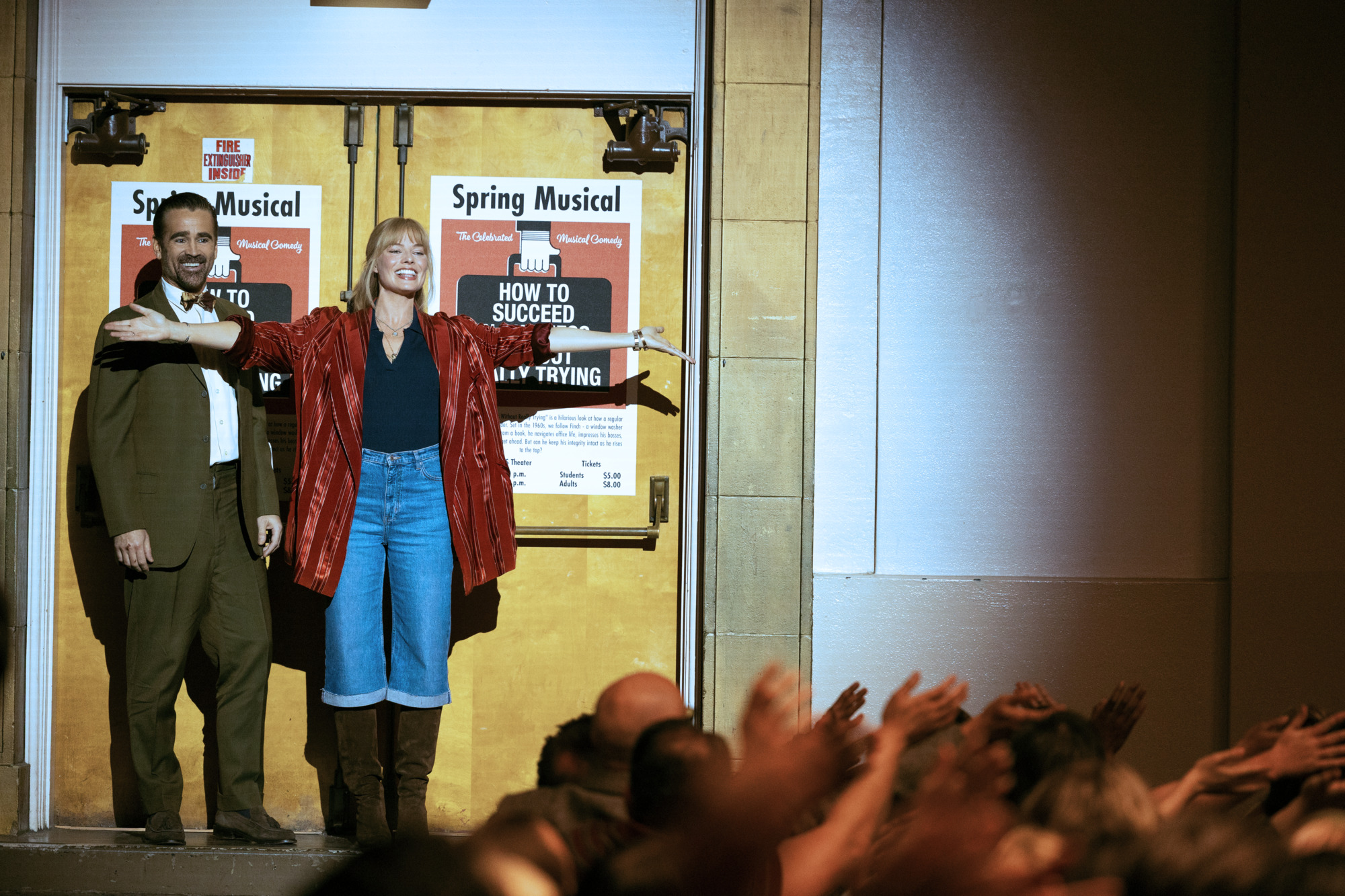
The lush, often poetic, use of magical realism in the picture actively works in its favor, especially when Kogonada “breaks” the artifice of the “film” David and Sarah star in and lets them release their emotions—naked, with no restraints a “set” may cause—within the confines of a theater stage. It makes Farrell and Robbie’s performances even more raw than they were. This is especially true in moments of great intimacy, when the two share their deepest regrets and then act on them in the movie’s climax.
Without spoiling a thing, that entire section—wherein the two travel to their most regretful periods of their childhood and resolve them differently—is so good that one can entirely ignore the movie’s perceived “flaws.” However, as a critic, one has to say that this Big Bold Beautiful Journey, in which Kogonada wants audiences to be, is not perfect. Then again, it is miles ahead of his previous directorial effort within the world of television. Knowing what bottom-tier Kogonada is might have prepared me for the realization that it somehow can’t get any worse. It didn’t.
Final Thoughts on A Big Bold Beautiful Journey
The undeniable sense of craftsmanship is present, the use of lively colors is staggering, and production designers Mary Florence Brown (Kindred) and Katie Byron’s (Booksmart, Zola, C’mon C’mon, Problemista, The Curse) set pieces transport audiences to a time that once was. The past is where its protagonists are forced to reminisce on parts of their lives they do not want to revisit. Yet, if we do—and if we remember some of our biggest regrets—, then perhaps it will give us permission to move into the future and become better individuals as we realize our mistakes and hope to God they won’t happen again when the next chapter of our lives begins.
Consequently, it’s hard to hate A Big Bold Beautiful Journey, even if one hopes the effort would have been more polished. Then again, considering Kogonada’s previous attempt at commercial entertainment, this bounce back feels like a minor win and a necessary step for him to find the joys in filmmaking again, as he prepares for his next masterpiece…
3/5
For more drama, fantasy, and romance-related news and reviews, follow The Cinema Spot on Facebook, Twitter, and Instagram! Also, follow us on Letterboxd for further feature film, short film, and limited series reviews!


