
Following the viral hit horror film, Cam, and the critically acclaimed eco-thriller film adaptation, How to Blow Up a Pipeline, filmmaking duo Daniel Goldhaber and Isa Mazzei return to theaters with an Independent Film Company and Shudder project, Faces of Death. Make no mistake, though. According to the filmmakers in the official production notes, this version of Faces of Death is “not a remake, nor a reboot. It is an exploitation of an iconic exploitation film. It brings the Faces legacy to the multiplex, confronting the nightmares of our small screens up on the big screen.” What works is that the project knows its material and understands that what is shown to viewers is not always real.
As with Cam, the film confronts the real with the surreal, the sphere of real life with the online sphere. It pokes at human beings’ skeptical minds by incorporating concerning imagery. There are moments wherein I found myself thinking, This is not happening. That is not to suggest that the writing is bad, but instead crafts windows into the world eerily close to ours. It juggles nihilism with realism but does not exactly strike a balance between optimism and pessimism. The horror film doesn’t tell us how to perceive but rather how to interpret and analyze widespread material.
Faces of Death is written by Daniel Goldhaber (Cam, How to Blow Up a Pipeline) and executive producer Isa Mazzei (Cam, How to Blow Up a Pipeline) and is directed by Goldhaber. Faces of Death is based on the Gorgon Video series of the same name.
In this review, I will discuss Faces of Death. As the article’s title states, no spoilers will be present.
IFC and Shudder’s Faces of Death Synopsis
According to Independent Film Company and Shudder, here is the official synopsis for Daniel Goldhaber and Isa Mazzei’s Faces of Death.
In FACES OF DEATH, the exploration of the original film’s infamous “is it real, or not?” conceit continues as a woman (Barbie Ferreira) working as a content moderator for a major video platform discovers what appears to be re-enactments of murders from the original film. In an online world where nothing can be trusted, she must determine whether the violence is fiction, or unfolding in real time.
Independent Film Company and Shudder
Discussion
Faces of Death takes certain risks to avoid going completely over the edge. Goldhaber and Mazzei’s screenwriting isn’t too violent for the sake of showcasing violence. Told in the basic three-act structure, the script is incredibly meticulous about the conveyed narration. Picture the meta-commentary of Wes Craven’s Scream franchise, but with the cruel nature of James Wan and Leigh Whannell’s Saw film franchise, especially with its A-plot/ B-plot narrative structuring between crimes occurring and the investigation into the matter. On that same note, the narrative parallels Michael Powell and Leo Marks’ Peeping Tom in terms of a young filmmaker recording his crimes.
Margot Romero (Barbie Ferreira) is tasked with allowing, flagging for removal, or placing a content warning on individual video footage that is uploaded to her workplace’s mobile application, Kino. Someone is hit by a truck, which then flips over; a woman falls onto the roof of a car; a bong rip; a cat licking a knife. That is, until she encounters video footage of executions narrated by Doctor Francis B. Gröss (Michael Carr). So much of the film is intentionally fake, and you might be thinking, Duh, it’s a film after all. Still, fabricated set pieces, scenarios, and spoken lines delude viewers into states of discombobulation and distraction. The horror tropes don’t get in the way of the overall narrative, which makes matters all the more effective.
The Rhetoric in the Writing
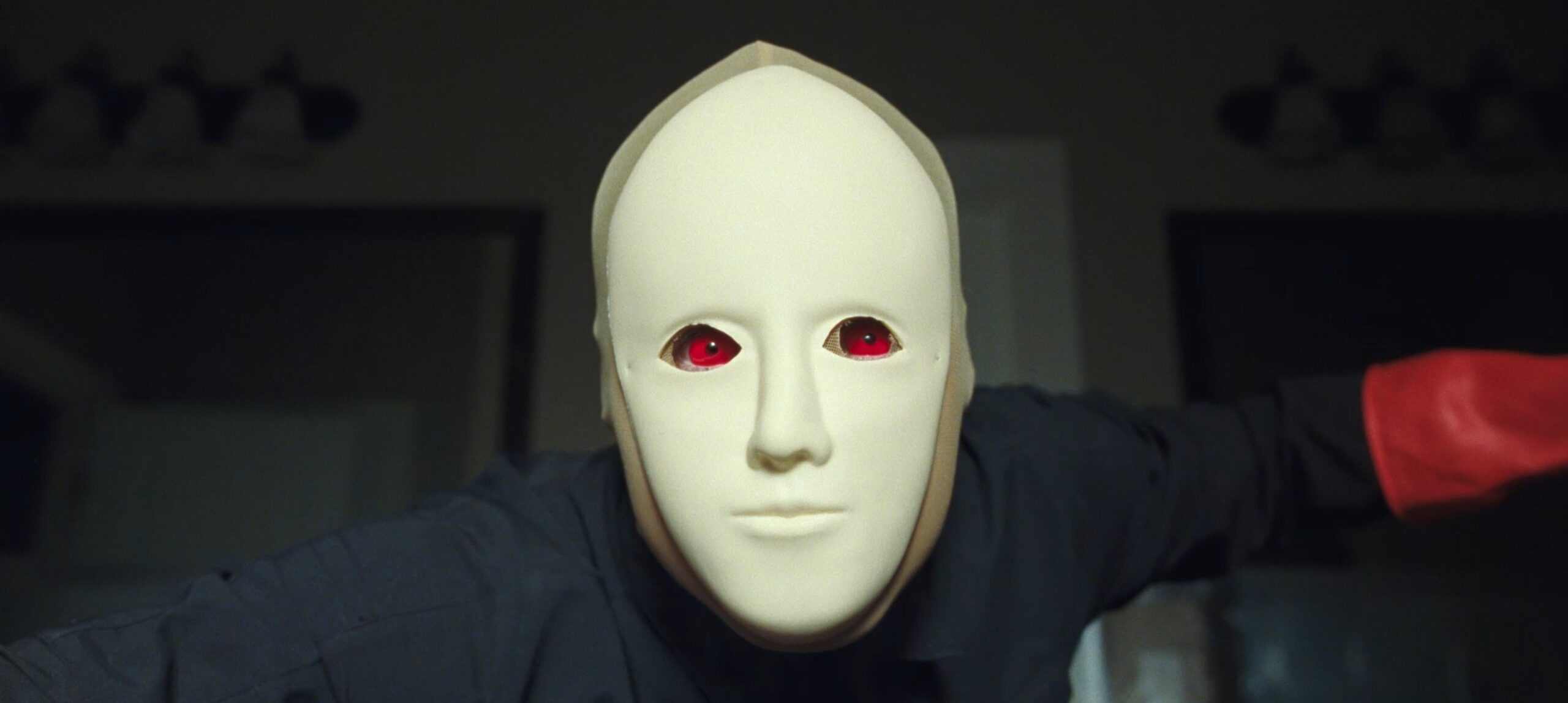
The narrative is rhetorically sound, which might be the shining aspect of Goldhaber and Mazzei’s script. Romero’s friend and roommate, Ryan (Aaron Holliday), is introduced painting a zombie on a canvas. It’s a nice symbol for death depicted within art. The rhetorical style in calling the fictional platform “Kino” as a satire of Vine, TikTok, and even Reels is clever. It refers to a movement that pushes for short films to be made on little-to-no budget with small production crews. Antagonist Arthur Spevak (Dacre Montgomery) describes it as a “zeitgeist”, and no other word can encapsulate a historical era that has come and will someday go.
Strange enough, that is the rhetorical invention made in 2026’s Faces of Death. In the digital epoché of FAANG (Facebook, Amazon, Apple, Netflix, Google), who keeps companies in check? That’s what makes hating the unlikable side character, Josh (Jermaine Fowler), so valid. He represents the faces—or really, the head employees—of these companies, such as Mark Zuckerberg and Elon Musk, who exacerbate global issues by manipulating the masses. Even TikTok is complicit in effacing videos expressing disdain for an ongoing genocide. As Mazzei states via the production notes, “I don’t think we’re desensitized to violence or extreme content so much as we have gotten used to living in a state of perpetual neurological stress. [D]oes watching make you complicit? [H]ow far removed is the moral imperative to not look away from ICE killings?”
At a time of artificial intelligence (AI) and misinformation dominating people’s psyches, the media has made it harsher to find our ways through wants, needs, and desires. As the recurring line goes, “Give the people what they want.” It’s also horrid how doxxing—i.e., the act of locating personally identifiable information—has become facilitated and weaponized today.
Faces of Surrealism
In terms of the logos, the narrative beats get a teensy predictable, and character actions are ridiculous for an otherwise outstanding horror film. Some objects introduced in the first act will obviously be of use in the finale. Other objects come across as anachronistic. I mean, who still uses a flip phone in this decade? Who owns two Video Home System (VHS) copies of Roland Emmerich and Dean Devlin’s Independence Day and two copies of M. Night Shyamalan’s The Sixth Sense, and yet only one copy of Jonathan Demme and Ted Tally’s The Silence of the Lambs and Tim Burton, Daniel Waters, and Sam Hamm’s Batman Returns apiece?? Clearly, the true sickness spreading throughout Faces of Death is taste and media literacy.
Then, there are other anomalies, e.g., sexual intercourse in a workplace stairwell, Charli xcx with a believable American accent, the viral crate challenge, and Spevak being a bit sloppy in a few rare instances. The filmmakers cite current “faces of death” as pervasive: “War crime. Meme. Online casino ad. Mass shooting. AI kitten. Political assassination.” Watching a slap at awards shows or videos of a cute Japanese macaque monkey should never turn our heads away from the more important issues at hand.
Goldhaber and Mazzei’s Society of the Spectacle
Faces of Death also deals with the faces of the real. Romero says it best at the end of the second act: “We watch this shit for entertainment, and we forget that these are real people with lives and families, and they’re not just a digital fucking image, right? [These are] real, real people are dying…” TikTok is to blame as an addiction social platform of recent years. Yes, it was once known as Music.ly, but it has not been bad before. In the production notes, Mazzei cites the rabbit holes of the Internet and lengths taken to obtain information: “When we go into that hole, we lose free will.”
Ultimately, 2026’s Faces of Death is centered on the attention economy of the current epoché. It points to the means of control through screens and the disconnect thereof as a result of this. As French philosopher and critical theorist Guy Debord states in his 1967 publication, The Society of the Spectacle:
The spectacle … is in reality the domain of delusion and false consciousness: the unification it achieves is nothing but an official language of universal separation … is a social relation between people that is mediated by images. [It] represents the dominant model of life. It is the omnipresent affirmation of the choices that have already been made in the sphere of production and in the consumption implied by that production.
Guy Debord, ‘The Society of the Spectacle’ pp. 10-11
The film as a Shudder release is reasonable because it frequently regards the individual as the new false god, social media as our church, mosque, synagogue, etc., and the Internet as our religion.
Facets and Façades of Death
Production designer Christopher Stull, art director John Sanchez, set designer Alexander Klein, and set decorator Elizabeth Humphrey deserve their roses for the specific look that Faces of Death has. Romero and Ryan’s sketchy brown-bricked apartment building; Spevak’s People Under the Stairs-esque dark brown household exteriors; the interiors of his home of a front door that leads straight into the kitchen and living room, with immediate access to the backyard, garage space, and “secret” basement. I’m most ambivalent about side character anchorman Neal Meyer’s (Kurt Yue) home. The space in a wall behind a living room couch is just as bad to me as the placement of the dining room table in Zach Cregger’s Barbarian. Meyer’s washroom, with its circuit breaker, is a neat narrative element.
According to the production notes, time was spent on lighting schemes for scenes recreated from the original Faces of Death. Otherwise, the film is its own aesthetic production. Gaffer Chip Carey’s lighting in a particular restroom scene and in and outside of Romero and Spevak’s home is the finest work I have seen in a horror film in a while.
Editors Taylor Levy, Meredith Mantik, Matthew Buckley, and Sam Salvodon’s assemblage of cuts is quite impressive work. The transitions between Romero and Spevak are excellent, whether they be director of photography Isaac Bauman’s shots of them looking in a bathroom mirror or close-ups of their eyes wide. I love the cuts between the television in Romero’s living room as it plays a snuff film and her face lit up with fear and the screen in her eyes. The fade into the third act merges the duality of the real and the surreal into one singular, suspenseful nightmare-scape.
Watch Your Tone
Music composer Gavin Brivik’s “musical sound” of a VHS tape functions “like a drum”. The retro-pop score gives off a true crime vibe to the narrative. It helps pace scenes along like a beast. I must also voice appreciation for music supervisor Joe Rudge’s song curation in the soundtrack. “Breathe Underwater” by Kasseo is lovely, and “Candy Floss” by Coco Morier blends upbeat pop with the film’s depiction of attacking and kidnapping. “1812 Overture, Op. 49” is masterful in Romero’s first actual confrontation with Spevak.
The Crew Behind Faces of Death
Isaac Bauman (Loki, They Will Kill You) serves as the director of photography. Brian Roedel serves as the stills photographer.
Chip Carey is credited as the gaffer.
Taylor Levy (Bodies Bodies Bodies, A Different Man) serves as the editor. Meredith Mantik, Matthew Buckley, and Sam Salvodon serve as the assistant editors.
Gavin Brivik (Cam, How to Blow Up a Pipeline, The Pitt) serves as the music composer.
Joseph “Joe” Rudge (Shark Night, The Sacrament, Hereditary, Midsommar, Ti West’s X and Pearl) serves as the music supervisor.
Nicholas Kmet (A Quiet Place Part II, Dead Ringers, Lisa Frankenstein, Madame Web, Eddington) serves as the music editor. John Carbonara is credited as the additional music editor.
Michael Odmark serves as the supervising sound editor.
Abby Harrison and Nick Caramela serve as the assistant sound editors. Yair Elazar Glotman and Paul Rudy do the musical sound design.
Brent Caballero serves as the casting director.
Chelsea Bruland serves as the stunt coordinator.
Lauren Nicole Trujillo serves as the Margot stunt double, while Angel Lia Spitale serves as the Samantha stunt double.
Eric Stratemeier serves as the Neal stunt double.
Michael Yahn serves as the Arthur stunt double.
Preston Schrag serves as the Ryan stunt double.
Hanna Hall (Bottoms, Lisa Frankenstein, Kinds of Kindness, Is God Is) serves as the intimacy coordinator.
Alex Kokenis serves as the VFX editor.
Aesthetics
Christopher Stull (Machete, Urge, From Dusk Till Dawn: The Series Season 3) serves as the production designer.
John Sanchez serves as the art director. Alexander Klein (We Have a Ghost, Five Nights at Freddy’s, Carry-On) serves as the set designer.
Elizabeth Humphrey (Scream: The TV Series Season 2) is credited as the set decorator.
Donnie Dean serves as the special effects coordinator.
Lauren Bott (Scream Queens, Cloak & Dagger) serves as the costume designer. Maura “Maude” Cusick (Scream Queens, Cloak & Dagger) serves as the assistant costume designer.
Lauren Thomas (The Final Girls, The Hunt, Night Teeth) is credited as the makeup department head.
Mat O’Toole (Dog Soldiers, Lisa Frankenstein, Carry-On) is credited as the key makeup artist. Hailey Authement and April Maness serve as makeup artists.
Margeaux Fox (Happy Death Day, Assassination Nation, Happy Death Day 2U, Bingo Hell, Carry-On) serves as the hair department head.
Emily Stegeman (The Hunt, Bingo Hell, Renfield) is credited as the key hairstylist.
Oscar Gale and Terez Ordon (We Have a Ghost, Imaginary, Carry-On, Is God Is) serve as the hairstylists.
The Cast of Faces of Death
Barbie Ferreira (Euphoria, Unpregnant, Nope) portrays Margot Romero, a content moderator for Kino Moderation, a short-form video-sharing platform.
Dacre Montgomery (Better Watch Out, Power Rangers, Stranger Things, Dead Man’s Wire) portrays Arthur Spevak.
Aaron Holliday (Euphoria Season 2, Cocaine Bear, I Love L.A.) portrays Ryan, Romero’s roommate and close friend.
Josie Totah (Spider-Man: Homecoming, Big Mouth Season 4, Mike Flanagan’s Carrie) portrays Samantha Gravinsky, who also goes by the username “SamGrav” online.
Jermaine Fowler (Sorry to Bother You, Am I OK?, The Blackening, Eenie Meanie, Appofeniacs, Night Patrol) portrays Josh, Romero’s boss and friend at Kino.
Kurt Yue (Black Widow) portrays Neal Meyer, a renowned anchorman.
Charli xcx (100 Nights of Hero, The Moment) portrays Gabby.
Ash Maeda portrays Drew, Meyer’s son.
Michael Carr appears in “diagetically sampled audio” as Dr. Francis B. Gröss, the narrator of John Alan Schwartz’s 1978 original film, Faces of Death.
Smaller Roles
Tiffany Colin portrays Margot’s sister, Sophie.
Sam Malone (American Ultra, Midnight Special, Project Power, Nickel Boys, Sinners) portrays Ed, a Kino security guard.
Brandon Sutton and Britton Webb portray Officers James and Rob, respectively.
Executive producer and co-writer Mazzei portrays “Narcan girl”.
Anja Avsharian and Anne Nichols Brown appear as “bodega girls”.
Stunt performer Walker Babington portrays Justin Podd, one of Spevak’s victims. Matt Story plays a beheaded man, whose name is eventually noted as “Buck Shaw”, one of Spevak’s victims.
Trenise Gray portrays a nurse practitioner.
Nathaniel Woolsey appears as a “nosy neighbor”.
Tadasay Young appears as Detective Lee.
Jared Bankens appears as Tom, Spevak’s colleague at Signaler Wireless.
Kyle Nordby plays a new hire.
Casey Ferrand is credited as a news reporter.
Betsy Borrego and Jonathan Shores appear as nurses.
Stunt performer Michael Yahn portrays a cab driver.
Performances and Character Developments
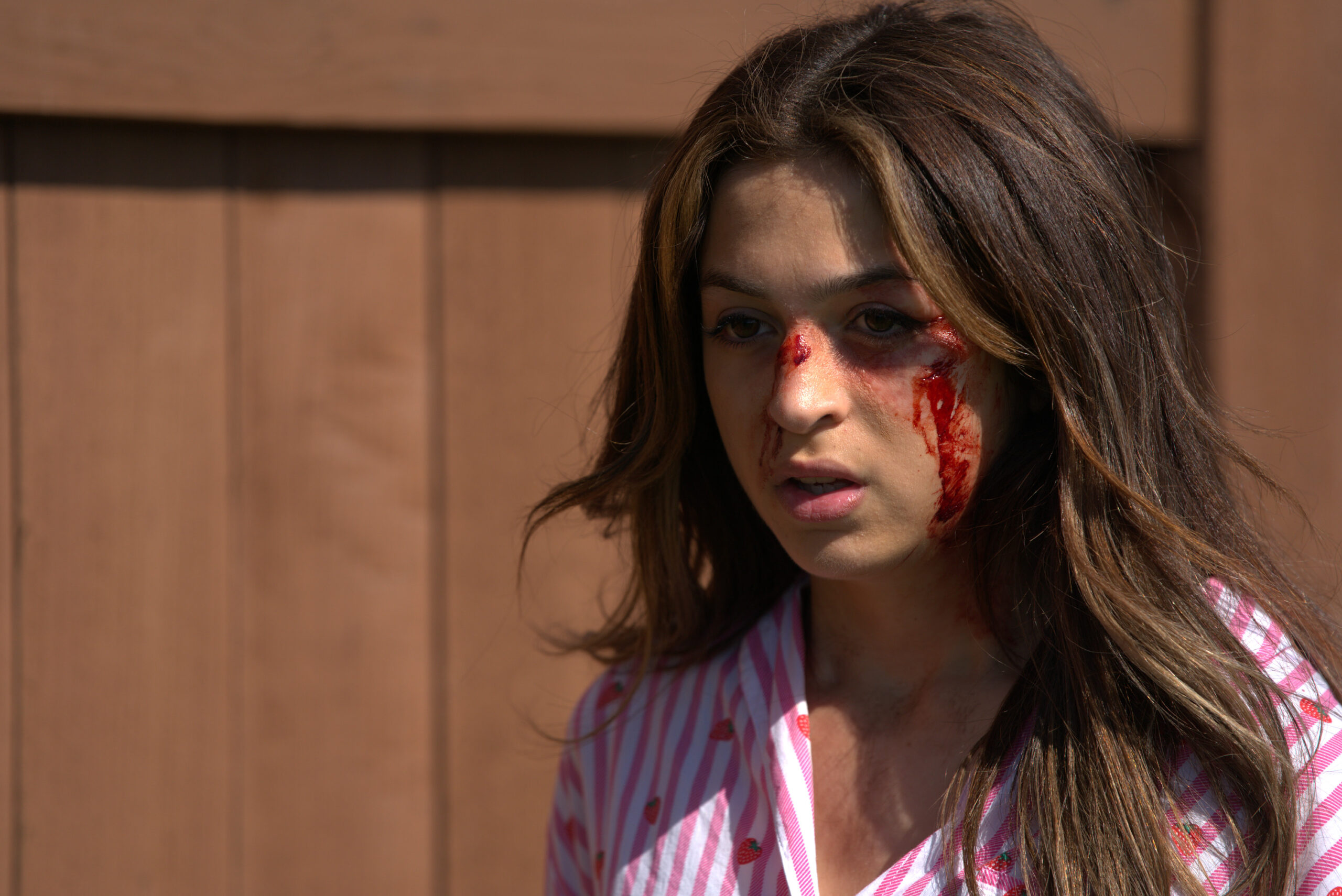
Ferreira offers a performance that has never been seen before. Whereas teenager Katherine “Kat” Hernandez found confidence while navigating high school, the role of Romero entails searching for solutions to absolve herself from grief. In contrast with the antagonist, the protagonist is inadvertently infamous for a viral video that also involves death. Ferreira outdoes herself in the finale, wherein she, her stunt double Lauren Nicole Trujillo, Montgomery, and his stunt double Michael Yahn physically struggle for life and social influence.
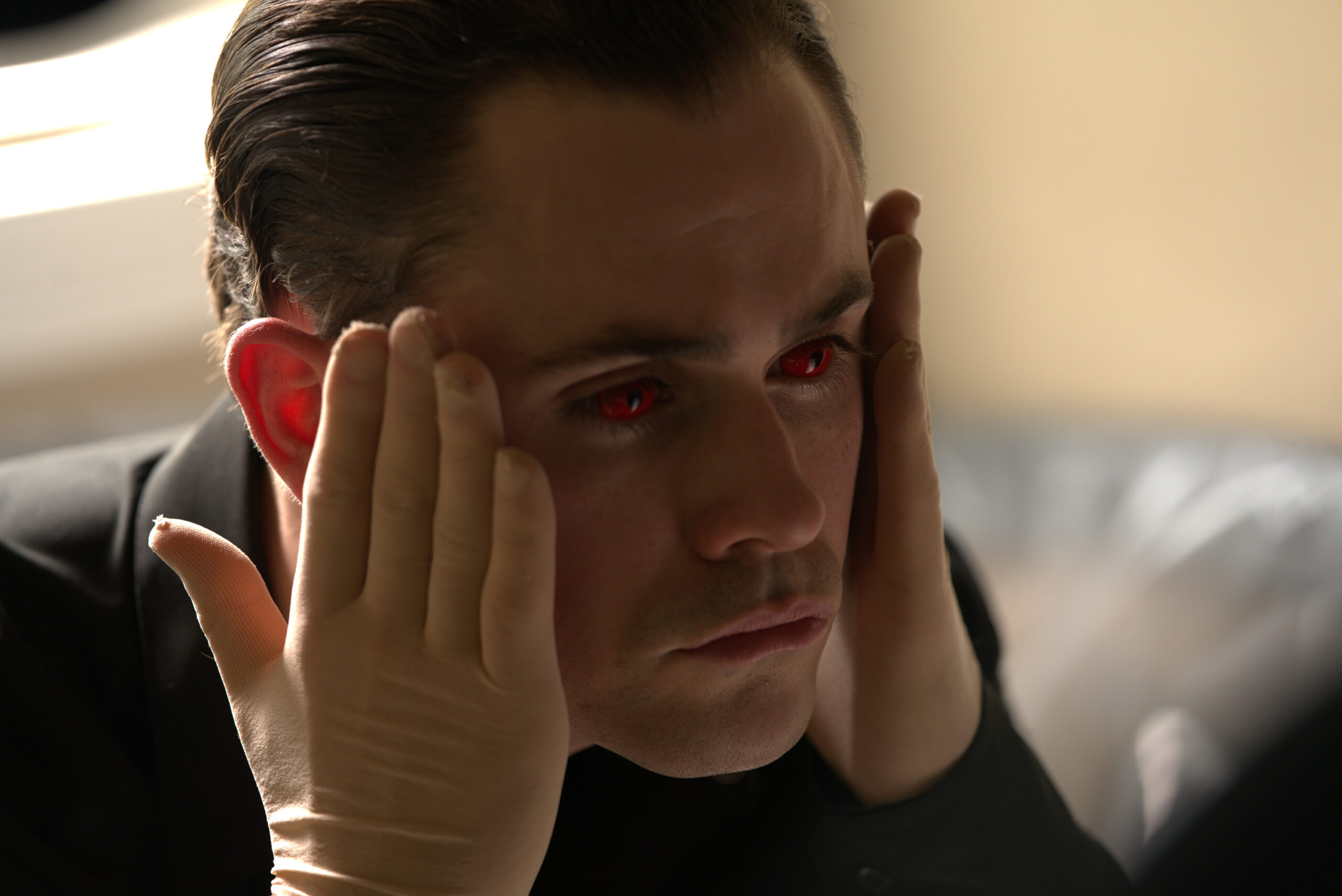
Montgomery has brilliant line readings, which only makes sense since he’s had phenomenal performances as Billy Hargrove in the Duffer Brothers’ Stranger Things from Seasons 2 to 4. As an antagonist, Arthur Spevak is described as a product of society and its “[l]ost, misguided souls”, which is fair to say because the Internet and social media has bred irreversible insanity on a massive scale. He isn’t just cruel for cruelty’s sake but vies for attention to an extreme degree. Additionally, the character possesses a dark sense of humor, such as punctuation mark decisions on Reddit threads or dancing to Michael Carr’s voiceovers. He’s the Joker with trollish behavior and without genuinely human smiles.
Supporting Characters
As for the supporting characters, Holliday’s Ryan is the only voice of reason I like. Goldhaber and Mazzei seem to have written the personality as if he were plucked from the pages of Scream. The meta-commentary dialogue at the beginning of the second act are glorious exposition. However, breaking down the character reaches a point, and I believe enough is present to care about him without trying to give him a wider background or backstory.
Alongside him is Josie Totah’s Samantha Gravinsky, another voice of reason. Given the circumstances, I feel as if the character has potential despite being a popular face within the confines of the narrative. Due to narrative pressure and time constraints, there isn’t room to develop the character further. Still, she is more decent of a side character than others. The vanity mirror that she abuses the shutter button in front of could be clever wordplay; “vanity” to mean conceit. It serves as an intelligent metaphor for the reflections of ourselves and our desires. It’s only fitting, then, to cast a Palestinian-Lebanese trans woman, representing those who aim to achieve the appearance they long for and will be satisfied with.
Final Thoughts on Faces of Death
While Cam was made on a budget of $1 million USD, Faces of Death was accomplished on a budget of $7.4 million. These differences don’t impact the storytelling. Yet, the latter film is a little more detailed in its mise-en-scène. Goldhaber and Mazzei’s project meets the standard for horror filmmaking, and then the gutsy final act drives the stakes even higher. In this case, the takeaway is that reducing screentime and our digital footprints is absolutely necessary. Danger lurks in open spaces, in every room, corner, and alcove. With these faces of death come the countenances that threaten you to count your days.
Daniel Goldhaber and Isa Mazzei’s Faces of Death comes exclusively to theaters on Friday, April 10th, and is expected to stream on Shudder later this year!
Have you seen the original Faces of Death movies? If so, then what are your thoughts on them so far? Let us know! For more horror-related news and reviews, follow The Cinema Spot on Facebook, Twitter, Instagram, and Bluesky! Also, follow us on Letterboxd for further feature film, short film, and limited series reviews!


