
How many people are truly willing to sacrifice it all to be utterly great? Will you go to hell and back to see that purpose through? Moreover, what even is the purpose? By definition, putting in ten thousand hours of practice towards whatever it is makes you great. Though, sometimes it feels impossible.
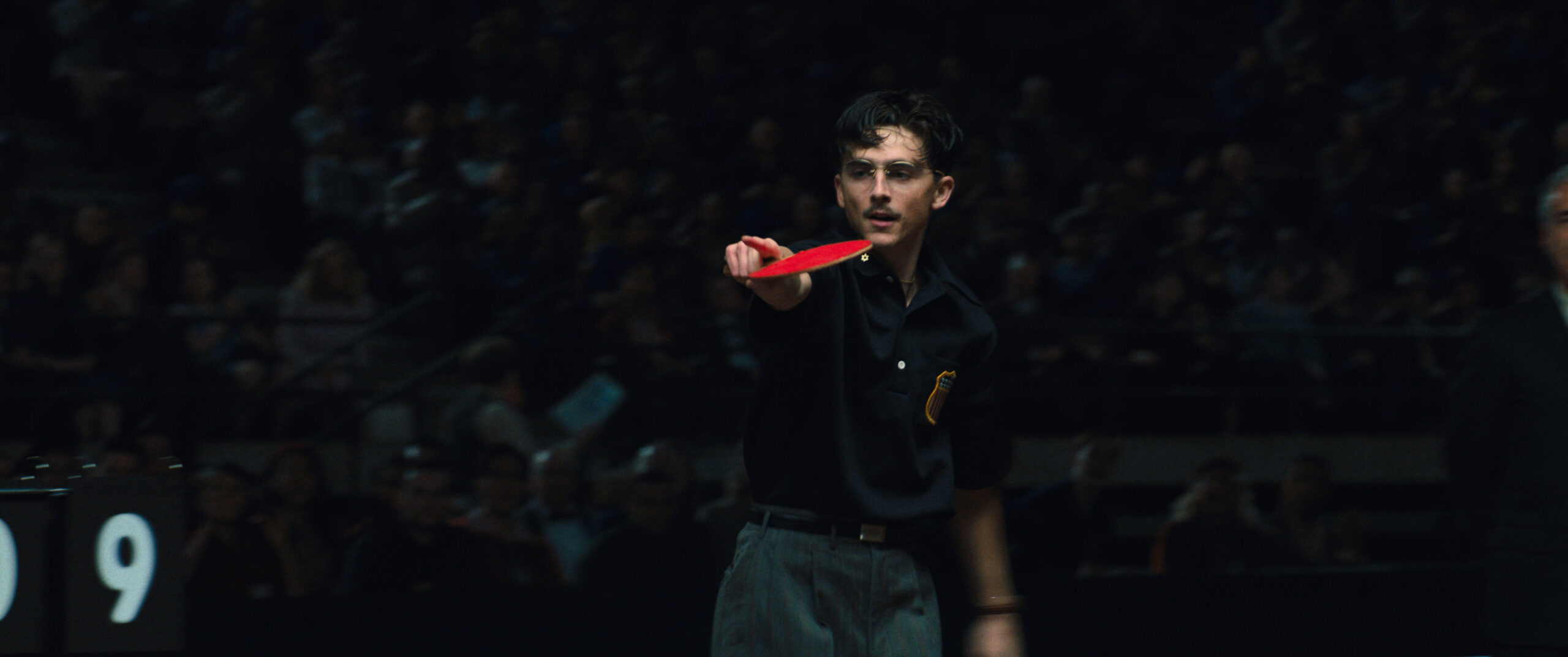
In Marty Supreme, young table tennis hustler Marty Mauser (Timothée Chalamet) will do whatever it takes to achieve that goal, which feels more like a fever dream by the time the credits roll. Co-written with producer Ronald Bronstein and expertly directed by producer Josh Safdie, Marty Supreme feels like a film made just for Gen-Zers. Make no mistake, the film contains elements everyone should appreciate. Marty Supreme produces the same feelings as his previous outings, Uncut Gems and Good Time: sheer anxiety and the want to see his main character win. For once, though, Mauser gets the best resolution of all three protagonists (Howard in Uncut Gems and Connie in Good Time). In this film’s final frame, Mauser finally feels like he’s won, even if he has never seen this winning right in front of him the entire time.
Beg, Borrow, Lie, and Steal
New York, 1952. If you know your history, the ’50s were a turning point for many. The Allies had defeated the Axis powers only seven years earlier, and particularly for the Japanese, the effects were still felt. For most, the effects are still felt today. Most working-class people were just trying to make it. 23-year-old Mauser wants to win, almost needs to win. From the opening moments in his uncle’s shoe store, it feels that Mauser is simply built differently, or is he? By the film’s final moments, he becomes just like most of us. At first, Mauser is a man on the edge, willing to do anything and everything to chase his dream of being the world’s biggest and best table tennis player. “You’ll be staring at me from the cover of a Wheaties box!” he exclaims to his nonchalant uncle, Murray (Larry “Ratso” Sloman).
Marty Supreme is perhaps the most quotable film of producer Chalamet’s career. Mauser’s brash cockiness is somehow extremely relatable. Even if it isn’t in sports or some outlandish realm, we can all be great within our own minds if we make it happen. However, it takes crashing out in the most ultimate form for Mauser to realise this by the film’s final moment, and it’s perfect. His crash-out begins quite quickly.
The Mauser Family
Without missing a single beat, Mauser quickly goes to collect a paycheck from his uncle, but the store is closed for the day. Wildly, he answers a call from his mother, Rebecca (Fran Drescher), and essentially goes off on her and proceeds to hang up on her in mid-rant. In the proceeding moment, realizing he has almost no other option, he pulls a gun out of a drawer in the store’s office. Calmly demanding his co-worker Lloyd (Ralph Colucci) give him what he’s owed, promising to give Lloyd a small cut of his winnings in the British Table Tennis Open. In these two moments alone, Mauser’s desperation is propelled on screen. Seemingly not realizing, or ignoring, that he has just committed a felony, like all of Mauser’s antics, it catches up with him after a short tour with the Harlem Globetrotters.
Marty Mauser’s Shenanigans

Mauser is so damn cocky that he hatches an almost too-good-to-be-true scheme before the final match of the British Open. In the lobby of The Ritz, he makes eye contact with Golden Age actress Kay Stone (Gwyneth Paltrow) and, through a couple of phone calls, smoothly convinces her to watch his match against Koto Endo (Koto Kawaguchi). Through his innate ability to match wits on the table, but come up just short, Stone feels attracted to this wild young man. However, it can be much inferred that, while he probably did feel some level of attraction towards Stone, he really wanted to meet her husband, businessman Milton Rockwell (Kevin O’Leary), to subtly help his ping-pong pipe dream.
Mauser is habitually broke. Even through a wild subplot involving a low-level gangster (Abel Ferrara) and his dog, he finds a way to make ends meet to get on the plane and go play ping-pong. Much of Mauser’s antics match the level of anxiety that Safdie does best at putting on the screen. It always pays off to witness, as baffling as it may seem. Many of his encounters are mere random chances, and if his dream doesn’t pay off? “That doesn’t even enter my consciousness,” he brags to Stone. However, it does by the end.
Cringe
Marty Supreme also contains quite the embarrassing moment for its protagonist, as is key to any Safdie lead. While Uncut Gems and Good Time both contain many of these moments, Marty Supreme only has one that truly stands out, adding to Mauser’s desperate desire to achieve greatness. In a last-ditch effort, he begs Rockwell that he will do anything to make a flight to Japan for the next championship tournament.
As any degenerate businessman would, Rockwell takes Mauser up on that offer, making him bend over a chair and literally spanking his ass with a ping-pong paddle in front of some other business associates, mostly to completely embarrass Mauser, but also for seemingly insulting his deceased son, who died fighting in the Pacific. It’s yet another example of the antics that Mauser will endure to feed his dream, even if the embarrassment meant nothing in the end. It’s absolutely outlandish to see what a Josh Safdie character will put themselves through for the simplest win. Yet, it begs the question, would any of us suffer at the same moment?
Is being a Family Man the Ultimate Win?
In the film’s opening moments, Mauser has sex with Rachel Mizler (Odessa A’zion), a childhood friend. As Safdie sometimes brilliantly does, the editing takes us through sperm latching onto an egg. This imagery forms into a ping-pong ball to produce the film’s title. That aside, Mauser and Mizler form an almost inseparable bond throughout, even if she does her own lying to capture her time at his side. However, juxtaposed with the film’s final moment, she has given birth to his presumed child. An almost irrelevant sidenote is that Mizler is married. With that said, her husband is quite the scumbag despite everyone’s own problems. Regardless, it’s largely implied that the baby is Marty’s.
In the best final moment of his career thus far, Mauser breaks down in tears at the sight of his child in the maternity ward, bringing the film full circle to what can truly make some of us great, the chance at parenthood, or family in general. Paired with an epic needle drop as the screen fades and the credits begin to roll, “Everybody Wants to Rule the World” by Tears for Fears plays.
Perfectly encapsulating Mauser’s journey thus far, has he truly achieved greatness, even if it’s right in front of him? Many would say so. Although, that’s what makes Marty Supreme such a powerful film. Even if that means “giving up” on his dream of table tennis greatness and a Wheaties box, his life finally seems to have more meaning than lying and deceiving to achieve a singular moment. Because when you get to the top, what is truly left?
Technical Elements
Safdie and Bronstein’s script is their most enticing yet. The simple resolution of Mauser not dying or being put in jail makes him a much more redeemable and relatable protagonist, something we can all achieve by the end of a bad day, or a short, bad run of luck. Marty Supreme comes full circle. Next to that, the needle drops at the beginning and the end set the tone so well. That is, when we’re young and chasing something where we cannot quite see the light at the end of the tunnel, until it smacks us on the ass at the weirdest or worst moment of youth.
Safdie and Bronstein also serve as editors on the film. They serve great cuts and smooth transitions from scene to scene, even in the film’s more chaotic moments. Safdie’s regular collaborator, cinematographer Darius Khondji (Se7en, Wimbledon, Uncut Gems, Mickey 17, Eddington), with music by Daniel Lopatin, continues a run of sheer artwork. Mauser is present in nearly every single frame and proves his point through quick-witted dialogue. Lopatin’s score amplifies the film’s anxiety and is used at the best moments.

The entire main cast bounces off one another perfectly. First-time actor Tyler Okonma—better known as artist Tyler, the Creator—plays against Chalamet in great fashion. This is done even with his minimal screen time. Paltrow and A’zion are two of the best co-stars alongside Chalamet. Each plays the love interest type differently. Yet, both bring power to the screen, caring about Marty in their own twisted ways.
Final Thoughts on Marty Supreme
Marty Supreme is easily one of the year’s best films, perhaps the best. Timothée Chalamet continues to demonstrate his dedication to the artform and is a perfect pairing with Josh Safdie. Feeling like it was made almost exactly for Gen Z, the film has so much to say. Similar to the actor’s last Christmas outing, A Complete Unknown, Marty Supreme should linger long after leaving the theatre. It should make you want to pump your fist as you walk back to your car. “Everybody Wants to Rule the World” has been on repeat for the last twenty-four hours. Ultimately, Marty Supreme should be a lingering note that greatness is waiting for us all. We just gotta chase it, whatever it may be for us all. Simply: DREAM BIG.
Josh Safdie and Ronald Bronstein’s Marty Supreme is now playing in theatres everywhere!
For more comedy and drama-related news and reviews, follow The Cinema Spot on Facebook, Twitter, and Instagram! Also, follow us on Letterboxd for further feature film, short film, and limited series reviews!


