
The wonderfully imaginative world of Oz has never felt this empty and lacking in any form of cinematic grandeur in the hands of Jon M. Chu with Wicked: For Good, the sequel to the 2024 mega Oscar-nominated hit Wicked, which itself was an adaptation of both the stage play of the same name by Stephen Schwartz and Winnie Holzman and the book from Gregory Maguire. Of course, the initial source material is the one that started it all, L. Frank Baum’s The Wizard of Oz, which opened our imagination in ways we never thought possible before Dorothy and Toto stepped into the land of Oz for the first time and changed the world of literature—and, by extension, art—for good.
Discussion
Chu possesses no sense of aesthetics or vision, and none is more apparent in how he makes every legendary set we visit in this on-screen transposition of the second act of Schwartz and Holzman’s play feel so small. Fans of the show know that the post-intermission half of Wicked is much darker and leans more into direct references to The Wizard of Oz than the first half. Yet, that doesn’t mean that every scene—whether representing a joyful development in Galina “Glinda” Upland’s (Ariana Grande-Butera) desire to represent the goodness of the world, or in flipping the story of Elphaba Thropp (Cynthia Erivo), the Wicked Witch of the West, to its head—should look this murky and unimaginative.
You would never know that the same guy who gave us, just a few years ago, In the Heights (with the same cinematographer and editor on that project, Alice Brooks and Myron Kerstein, respectively), a dazzling and emotionally powerful adaptation of Lin-Manuel Miranda’s best musical, is in charge of every decision in the cinematic diptych of Wicked. Instead of expanding upon the playful and often expressionistic photography developed with Brooks in his prior work, which enhanced the emotion of the scenes, characters, and musical numbers, Chu has no idea where to place the camera or what to film during every single scene of this dreary affair. It’s especially strange because, in the case of Wicked, you must visually represent a world that should consistently instill awe and wonder among audiences, young and old, and tickle their imagination in a manner that the real world prevents you from doing so.
The Technical Aspects of Wicked: For Good
Minor stylistic flourishes, such as swift pans, the employment of mirrors, or practical split screens, never read as artistic tools that enhance the work of both Grande and Erivo, who are still sensational in a musical that sadly wastes their talent behind the choices made in this head-scratching blockbuster. The big dramatic numbers, “No Good Deed” and, of course, the titular song, “For Good,” never have their intended effect because one cannot appreciate the talents of Erivo and Grande with a camera that doesn’t know how to capture them, especially at a purely emotional level.
Every composition is flat. There’s no sense of perspective or depth of field, and the colors are even more muted and washed-out this time around than in the last movie, which had its fair share of baffling color schemes, such as bathing Jonathan Bailey’s Prince Fiyero in white light, which should theoretically be the sun! What are we doing here? And why are we accepting this as “good,” let alone nominating it for awards?!?
Jon M. Chu’s Direction
Chu possesses an understanding of the potential of cinema as a visual medium, as illustrated in his Step Up sequels (Step Up 3D may be the best one of the bunch), G.I. Joe: Retaliation, and, of course, In the Heights. However, in Wicked, he feels completely overwhelmed by the sheer ambition of the material and falls short of cinematically translating the play in every aspect. One cannot fully appreciate the craftsmanship of Nathan Crowley’s production design, or Paul Tazewell’s costumes, because, under the weight of Chu’s camera, they don’t feel as expressive and as beautiful as they likely were on set.
But you already knew all of these things, because everything that didn’t work in the first installment of Wicked doesn’t work in For Good, as both films were shot back-to-back. Fine-tuning was pretty much impossible after the first movie’s release, especially considering that it became a hyped Oscar contender. Why change a winning formula when an audience that has no standards will accept it as something worthwhile, right?
Adapting Wicked Act Two
Well, none of them seemed to have factored in that the second act of Wicked is historically not as well-received as when Elphaba flies high in the sky and defies gravity. It certainly has its moments (notably, “For Good”), but its insistence on connecting all of its threads to The Wizard of Oz, and haphazardly so, sinks most of the narrative development of Schwartz and Holzman’s first act. Theatrically, though, the production is expansive enough for an audience member, moved by its sheer artistry and thunderous performances, to overlook some of its storytelling flaws. Cinematically, Chu’s transposition leaves so much to be desired. His direction is threadbare, Kerstein’s cutting feels arbitrary and never serves the emotional core at the heart of Erivo and Grande’s performances, and sections where we should theoretically feel something never land.
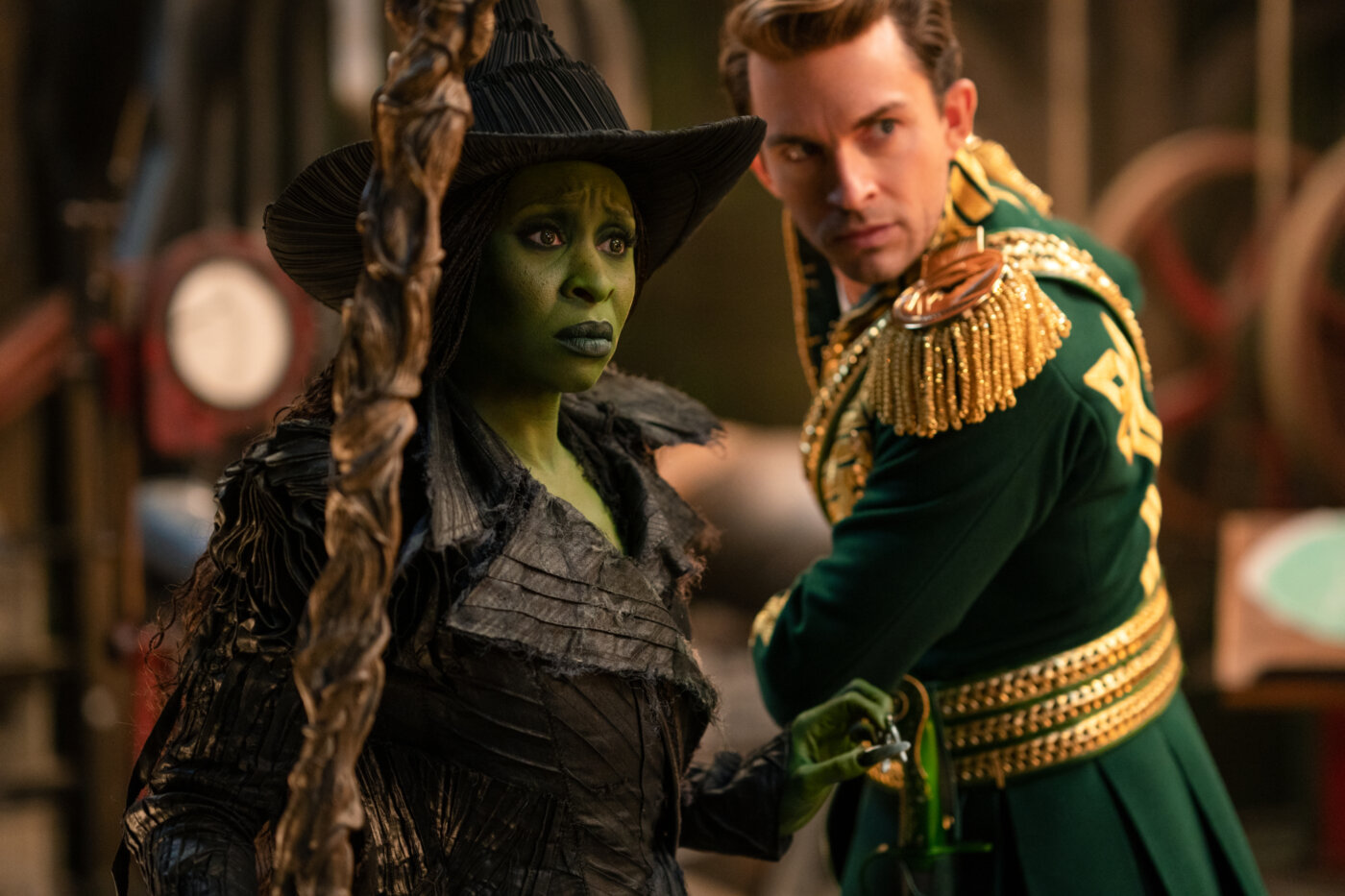
Inspired by The Wizard of Oz
It’s hard to mention anything without spoilers, since the sequel has more developments than the original Wicked (although there are no surprises for anyone who has seen the show). However, I can mention that there is a character who gets crushed by Dorothy’s house as she enters the land of Oz. It’s a tragic end to a person whom Elphaba holds near and dear to her heart. Yet, the scene is so poorly shot and edited that most of the audience in the sold-out IMAX auditorium let out unintentional laughter. It wasn’t the last time they would do so at scenes that aren’t funny and actively work to develop Glinda and Elphaba’s feelings for each other, particularly the head-scratching reveals on the Wizard of Oz’s (Jeff Goldblum) connections with the Wicked Witch (and the most horrific use of de-aging I’ve likely ever seen) and, most hilariously, Fiyero’s fate.
Connections to The Wizard of Oz make little narrative or cohesive sense and hamper much of the quasi-emotional momentum built in the first half. In fact, none of the plotlines introduced in that section are paid off in this second part, even less in the filmic version. In the movie, there is a desire to expand on both Glinda’s and Elphaba’s personal journeys of self-actualization, but never in a way as emotionally impactful as in the play. It’s an ugly-looking, thunderously boring nightmare of a second part that feels more in line with bad fanfiction you would read on Reddit than something that meets the moment and holds space for both admirers of Baum’s world and the people who are entirely unfamiliar with the source material, and want to be blown away.
The Ultimate Takeaway
I hate to say just watch The Wizard of Oz, but there’s a reason why Victor Fleming’s 1939 film continues to stand the test of time, even if the Las Vegas Sphere has tried to bastardize it with generative AI. It’s a timeless classic for a reason: it still tickles anyone’s imagination and makes them dream of a world far larger in scale, scope, and emotion than the dreary, black-and-white confines of real life. Sure, there’s no place like home, but what’s instilled in Baum’s story, and, by extension, Fleming’s movie, is second-to-none. Chu offers nothing in Wicked that isn’t first-rate slop, a production that falls short of the ambitions of Schwartz and Holzman’s play by simply not having the cinematic desire to do something unique and wonderful with the material at hand.
Final Thoughts on Wicked: For Good
Reducing “Defying Gravity” and “For Good”, two of the most powerful songs in Broadway history, to unimpressively-constructed musical numbers with little to no emotional power, is a Herculean feat, but this is what Chu accomplishes in his deathly dull diptych, possessing no artistic vision of his own to make these Wicked adaptations the ultimate cinematic counterpoint to Fleming’s The Wizard of Oz. When Sam Raimi’s Oz: The Great and Powerful has more color and verve than your cinematic adaptation of one of the most successful and vivid plays known in contemporary theater, there is a massive problem. Sadly, fans don’t care, and neither do mainstream audiences, who think what they’re getting is somehow acceptable when it’s so far below the standards that Hollywood used to have just not long ago…
Jon M. Chu, Winnie Holzman, and Dana Fox’s Wicked: For Good is now playing in theaters!
For more fantasy, musical, and romance-related news and reviews, follow The Cinema Spot on Facebook, Twitter, and Instagram! Also, follow us on Letterboxd for further feature film, short film, and limited series reviews!


